Aerial view of Indiana University Bloomington campus with limestone Gothic buildings and autumn foliage

Indiana's World-Class Universities

From the limestone spires of Indiana University to the engineering halls of Purdue and the golden dome of Notre Dame — Indiana's campuses are extraordinary destinations in their own right.

A State Built on Knowledge and Discovery

Indiana is home to more than 30 colleges and universities, including two flagship Big Ten research universities, one of the most storied private universities in America, and a constellation of smaller institutions that collectively serve the educational needs of hundreds of thousands of students each year.

Indiana's commitment to higher education is deep and longstanding. Indiana University, founded in 1820 — just four years after Indiana achieved statehood — is one of the oldest public universities west of the Allegheny Mountains. Purdue University, established in 1869 under the Morrill Land-Grant Act, has grown from a modest agricultural college into one of the world's preeminent research universities in science, technology, engineering, and mathematics. The University of Notre Dame, founded by French missionaries in 1842, has become synonymous with academic excellence and athletic glory of the highest order.

Together, Indiana's universities generate a combined economic impact of tens of billions of dollars annually, attract students from all 50 states and more than 100 countries, and produce research that shapes medicine, technology, agriculture, policy, and culture on a global scale. For travellers, these campuses offer extraordinary destinations in their own right — beautiful architectural landscapes, world-class museums and performance halls, vibrant social and cultural calendars, and a palpable sense of intellectual excitement that pervades every corner.

Campus Visiting Tip

Most Indiana university campuses welcome visitors year-round and offer self-guided and guided tours. Spring and autumn are the most visually stunning times to visit, with flowering trees in April and spectacular fall colour in October. University athletics — particularly football and basketball — create electric social atmospheres on home game weekends that offer a uniquely American cultural experience.

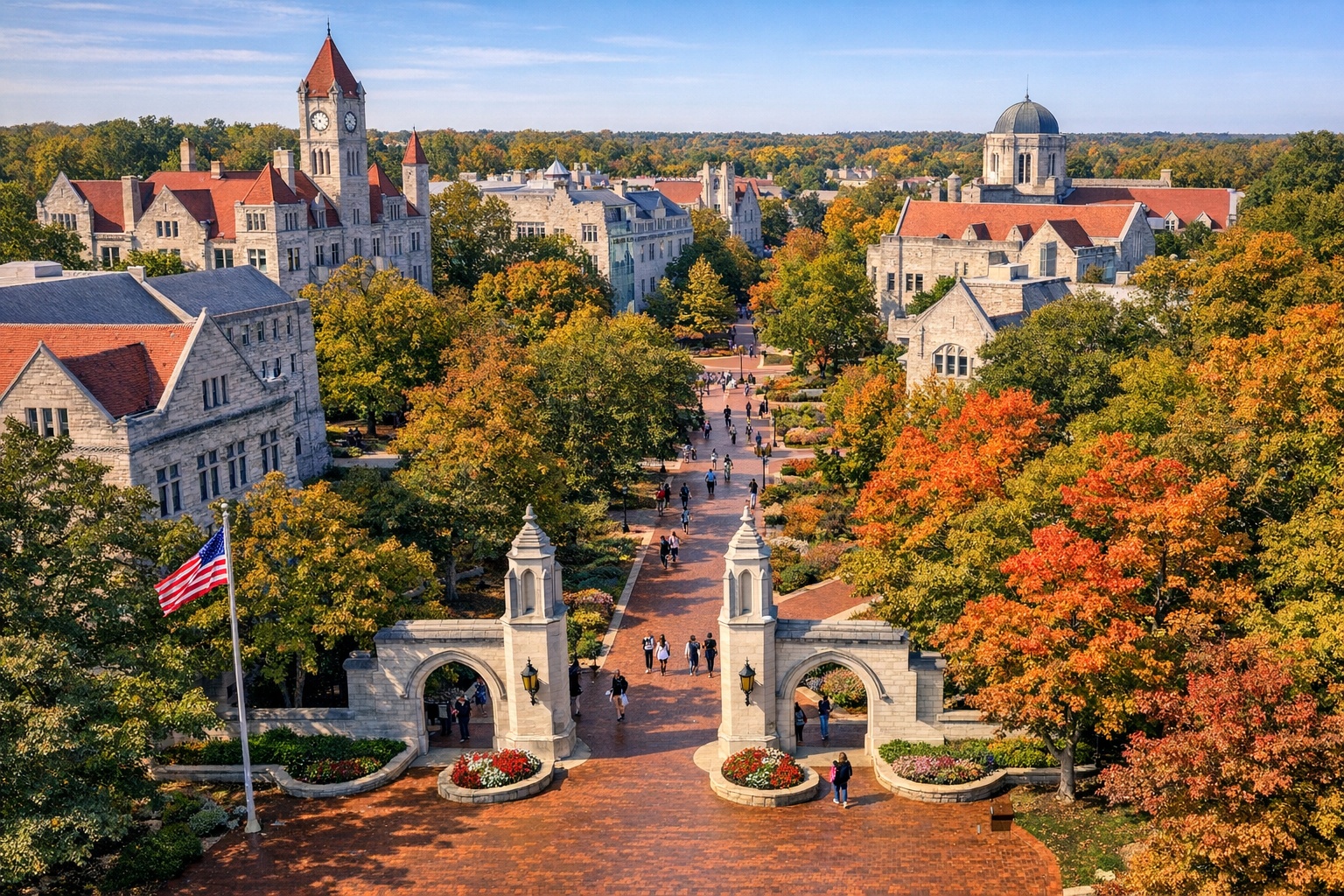
Indiana University Bloomington's iconic limestone Gothic campus buildings surrounded by autumn trees

Indiana University Bloomington

Indiana University Bloomington (IU) is the flagship campus of Indiana University and one of America's great public research universities — a place that combines the intellectual resources of a major research institution with the vibrant social energy of a classic Big Ten college town. Founded in 1820, IU Bloomington enrolls approximately 47,000 students and employs over 2,500 faculty members across 17 degree-granting schools.

The campus itself is breathtakingly beautiful. Situated on nearly 2,000 acres of gently rolling terrain in south-central Indiana, IU Bloomington is characterised by its distinctive Indiana limestone architecture — warm-toned, textured stone quarried from the Bedford-Bloomington stone belt, used to construct virtually every major building on campus. The Sample Gates, the campus's iconic stone entrance on Indiana Avenue, frame a vista of tree-canopied pathways that invite leisurely exploration at any time of year.

IU Bloomington's academic reputation is particularly strong in music, law, business, public affairs, informatics, journalism, and the social sciences. The Jacobs School of Music is consistently ranked among the finest music conservatories in the world, presenting an astounding programme of over 1,000 public performances annually — from student recitals to full operatic productions in the world-class Musical Arts Center — at remarkably accessible prices.

  • Founded 1820 — one of America's oldest public universities
  • ~47,000 students; 17 degree-granting schools
  • Jacobs School of Music: top-ranked conservatory, 1,000+ annual performances
  • IU Art Museum: 45,000+ works, exceptional European and African collections
  • Lilly Library: rare books and manuscripts of global significance
  • IU Hoosiers: 24 NCAA national championship titles across multiple sports

The IU Campus Experience

Exploring the IU Bloomington campus is a deeply rewarding experience for visitors of any background. The Indiana Memorial Union — at over 500,000 square feet, one of the largest student unions in the world — contains restaurants, hotel accommodation (the IMU Hotel is a charming destination in its own right), a bowling alley, a billiard room, and a remarkable collection of public artwork including a magnificent Wood Pulpit from Canterbury Cathedral.

The Lilly Library houses one of the finest collections of rare books, manuscripts, and historical documents in the United States — including first editions of Chaucer and Shakespeare, a Gutenberg Bible, original documents from the American Constitutional Convention, and thousands of other treasures accessible to researchers and exhibited to the public in rotating displays. The library's exhibitions are free and open to visitors without reservation.

IU's Jordan Hall of Science is a state-of-the-art LEED-certified building designed by Pei Cobb Freed and Partners that has become one of the campus's signature architectural achievements. The Global and International Studies Building, designed by Ennead Architects, is another visually striking addition that reflects IU's ambitious global engagement mission.

Bloomington's student life extends well beyond campus. Kirkwood Avenue and College Avenue — the main commercial streets connecting downtown Bloomington to the university — are lined with independent bookshops, coffeehouses, restaurants representing cuisines from around the world, music venues, and galleries. The Buskirk-Chumley Theater, an historic 1922 vaudeville house that has been lovingly restored, presents an eclectic programme of live music, film, and performing arts.

IU Athletics: The Hoosiers

Indiana University's athletic programme is legendary in American college sports, with a particular legacy in basketball that borders on the sacred in Indiana. The IU Hoosiers men's basketball programme has won five NCAA national championships — in 1940, 1953, 1976, 1981, and 1987 — and produced a remarkable lineage of NBA stars and coaches. Assembly Hall (now Gainbridge Fieldhouse on IU's campus is called Simon Skjodt Assembly Hall), with its capacity of nearly 17,500, creates an extraordinary atmosphere for Big Ten conference games that is regarded as one of the finest experiences in college basketball.

IU football — long overshadowed by the programme's basketball glory — has enjoyed a renaissance in recent years, with Memorial Stadium filling to its 52,000-seat capacity for key Big Ten matchups. IU's swimming programme is perhaps the most decorated in the nation, with the men's team winning 20 consecutive Big Ten championships at one point in the 20th century.

Purdue University West Lafayette campus with red brick buildings and students walking on autumn pathways

Purdue University, West Lafayette

Purdue University is Indiana's land-grant institution and one of the world's preeminent research universities in science, engineering, technology, and agriculture. Founded in 1869 and named for benefactor John Purdue, the university has grown from a modest agricultural college into a global powerhouse of research and innovation that has shaped the modern world in ways both visible and profound.

Purdue's contributions to space exploration alone make it arguably the most historically significant university in American history for a single field. More than two dozen Purdue graduates have flown in space, including Neil Armstrong — the first human to walk on the moon — and Gus Grissom, one of the original Mercury Seven astronauts. The university's Neil Armstrong Hall of Engineering stands as both a functional academic facility and a monument to Purdue's extraordinary aerospace heritage, with a dramatic architectural form that evokes a rocket preparing for launch.

Purdue's main campus in West Lafayette encompasses over 2,400 acres along the eastern bank of the Wabash River, with approximately 10 million square feet of academic buildings, research facilities, and student amenities. The campus architecture blends redbrick Georgian buildings with modernist structures, creating a visually harmonious environment of considerable beauty.

  • Founded 1869 — Indiana's land-grant university
  • ~50,000 students; one of America's largest research universities
  • 23+ Purdue graduates have flown in space, including Neil Armstrong
  • College of Engineering: consistently top-5 ranked in the nation
  • Purdue Research Park: one of the nation's largest university-affiliated research parks
  • Boilermaker Special: the iconic Purdue mascot trains are campus legends

Academic Excellence and Research Impact

Purdue's academic reputation rests on the exceptional quality of its STEM programmes. The College of Engineering consistently ranks among the top five engineering schools in the nation, producing graduates who lead major corporations, research laboratories, and government agencies worldwide. The Purdue Polytechnic Institute — the nation's first new polytechnic institution in 50 years — is pioneering new approaches to technology education that are being replicated by universities across the country.

The university's research output is extraordinary. Purdue Discovery Park District encompasses a constellation of cutting-edge research institutes focusing on topics from quantum computing and artificial intelligence to global food security and advanced manufacturing. The Purdue Applied Research Institute is one of the nation's leading centres for defence and national security technology development, with close partnerships with the U.S. Department of Defense and major aerospace contractors.

The College of Agriculture — Purdue's founding college — remains one of the world's premier agricultural research institutions. Its work on crop genetics, sustainable agriculture, food systems, and international development has directly contributed to reducing hunger on a global scale. The college's undergraduate programmes in agricultural science, food science, and agribusiness attract the brightest students from farming communities across America and around the world.

Campus Highlights for Visitors

The Purdue campus offers numerous points of interest for visitors. The Neil Armstrong Hall of Engineering's lobby contains a compelling exhibition on Purdue's aerospace heritage, including memorabilia connected to Armstrong and other Purdue astronauts. The Purdue University Memorial Union — nearly as large as IU's and similarly storied — features beautiful public spaces, dining options, and the Purdue Memorial Union Club Hotel. The Loeb Fountain in the Engineering Mall is a beloved campus landmark. The Purdue Marching Band — the "All-American" Marching Band — is one of the most prestigious and visually spectacular marching ensembles in American college football.

A young woman college student sitting on campus steps at a university in Indiana, reading a textbook with campus buildings behind her

The Indiana University Experience

Life on Indiana's university campuses is rich, diverse, and intellectually stimulating. Students from all 50 states and more than 100 countries converge on these campuses each year, creating multicultural communities of extraordinary diversity and vitality. Whether studying in a limestone-walled library at IU, working in a cutting-edge engineering lab at Purdue, or attending a midnight vigil at the Grotto of Our Lady of Lourdes at Notre Dame, every student finds something unique and transformative in Indiana's higher education landscape.

Campus visits — whether for prospective students or simply curious travellers — are warmly welcomed at all of Indiana's major universities. Free guided tours depart from admissions offices and visitor centres daily, providing both architectural and academic perspectives on these remarkable institutions. Most campuses also host public events — lectures, performances, exhibitions, and athletic competitions — that are open to the broader community.

The surrounding college towns further enrich the experience. Bloomington's restaurants, music venues, and natural surroundings (including the Monroe Reservoir and the Griffy Lake Nature Preserve) make it a highly liveable environment. West Lafayette and Lafayette together form a dynamic community with excellent dining, a thriving arts scene, and remarkable outdoor recreation along the Wabash Heritage Trail.

University of Notre Dame, South Bend

The University of Notre Dame, located just north of South Bend in St. Joseph County, is one of the most recognisable and revered universities in the entire United States — a place where academic excellence, Catholic intellectual tradition, and athletic glory converge in a campus of extraordinary beauty. Founded in 1842 by Father Edward Sorin, a young French priest of the Congregation of Holy Cross, Notre Dame has grown from a single log chapel in the Indiana wilderness into a comprehensive research university of global significance.

The campus is simply stunning. The Golden Dome atop the Main Building — covered in genuine gold leaf and crowned by a statue of the Blessed Virgin Mary — is one of the most recognisable architectural symbols in American higher education. The Basilica of the Sacred Heart, consecrated in 1888 and inspired by the Gothic cathedrals of France, is arguably the most beautiful building in Indiana — a soaring stone structure filled with extraordinary stained glass, ornate chapels, and a profound atmosphere of spiritual devotion.

Notre Dame Lake and St. Mary's Lake on the north and south sides of the main academic mall provide a tranquil natural setting that softens the grandeur of the stone buildings. The Grotto of Our Lady of Lourdes — a replica of the famous grotto in Lourdes, France, tucked beneath tall pine trees near the lakes — is a place of quiet pilgrimage that draws visitors of all faiths throughout the year.

Academically, Notre Dame consistently ranks among the top 20 national universities in the U.S. News and World Report rankings. The university's law school, business school (Mendoza College of Business), and theology programmes are particularly celebrated. The Hesburgh Libraries, named for the legendary university president Theodore Hesburgh who served from 1952 to 1987, house over 3.5 million volumes and feature the iconic mural "The Word of Life" — nicknamed "Touchdown Jesus" by football fans — on the south exterior wall overlooking Notre Dame Stadium.

Notre Dame Football: A National Obsession

Notre Dame football is a cultural phenomenon that transcends college sport. The Fighting Irish — one of only a small number of college football programmes to maintain an independent (conference-less) status in the FBS — have won 11 consensus national championships and produced 7 Heisman Trophy winners over the programme's storied history. Notre Dame Stadium, expanded to a capacity of 77,622, is one of the most atmospheric venues in American sport, particularly on home game Saturdays when the entire campus transforms into a festival of gold and blue.

The traditions of Notre Dame football — the pre-game Walk with the players, the echoes of victory from the Hesburgh Library mural, the passionate roar of 77,000 fans in the stadium, the stirring performance of the Notre Dame Victory March — create an experience that visiting fans almost universally describe as deeply moving regardless of their team allegiance. Attending a Notre Dame home football game is, quite simply, one of the most memorable sporting experiences available anywhere in the United States.

More Outstanding Indiana Universities

Indiana's higher education landscape extends well beyond its flagship institutions.

Butler University, Indianapolis

Butler University, founded in 1855, is one of Indiana's most prestigious private universities and enjoys national recognition far exceeding its modest size of approximately 5,000 undergraduates. Located in the Fairview neighbourhood just north of downtown Indianapolis, Butler's beautiful campus — centred on the historic Holcomb Gardens and the sparkling Jordan River — occupies 295 acres of parkland that is consistently rated one of the most beautiful small university campuses in America.

Butler's College of Pharmacy and Health Sciences is one of the oldest and most respected pharmacy schools in the nation. The Jordan College of the Arts — Butler's conservatory division — produces world-class graduates in dance, music, theatre, and arts administration. The university's basketball programme, meanwhile, achieved national fame and affection through back-to-back runs to the NCAA Championship Game in 2010 and 2011 — capturing the imagination of the entire nation as a small school competing with the sport's giants.

Butler's campus features the renowned Clowes Memorial Hall, one of Indiana's finest performing arts venues, which presents a year-round programme of professional touring productions ranging from Broadway musicals to opera, ballet, and classical music. The Indianapolis Symphony Orchestra performs regular concert series at Clowes, making it a cultural anchor for the entire city.

Ball State University, Muncie

Ball State University in Muncie — founded in 1918 and named for the Ball brothers of Ball jar fame who donated the original campus — is a comprehensive public research university enrolling approximately 20,000 students across seven academic colleges. Ball State's architecture programme is nationally recognised, producing graduates who have contributed to notable built works across the United States. The university's College of Communication, Information, and Media is one of the strongest journalism and media programmes in the Midwest, and its immersive learning programme — which embeds students in real-world projects from their first semester — has become a model for experiential education nationally.

Muncie itself — once a major glass manufacturing centre immortalised by the landmark sociological study "Middletown" (1929) — offers a genuine slice of small-city Midwestern life. The David Owsley Museum of Art on the Ball State campus houses an exceptional permanent collection of more than 11,000 works that is free to the public.

Indiana State University, Terre Haute

Indiana State University in Terre Haute was founded in 1865 and currently enrolls approximately 12,000 students. The university's strongest programmes include nursing, education, criminal justice, and aerospace technology — the latter operating one of the finest aviation training facilities in the Midwest from the Terre Haute International Airport.

Indiana State is perhaps most famous as the alma mater of NBA legend Larry Bird — arguably Indiana's most beloved sports figure — whose extraordinary college career at ISU culminated in the 1979 NCAA Championship Game against Magic Johnson's Michigan State Spartans in a clash that many consider the most watched college basketball game in history. The Larry Bird statue on campus and the Larry Bird Sports Complex are points of pride for the entire Indiana State community and pilgrimage destinations for basketball fans from around the world.

University of Indianapolis

The University of Indianapolis, a private liberal arts institution affiliated with the United Methodist Church, occupies a beautiful 65-acre campus on the south side of Indianapolis. With approximately 6,000 students, UIndy offers strong programmes in health sciences, education, business, and the arts. The university's athletics programme competes at the NCAA Division II level and has produced multiple national championships in cross country and track and field.

The university's honours college and undergraduate research opportunities are particularly well-regarded, and UIndy's strong community partnerships provide students with exceptional experiential learning opportunities in one of America's fastest-growing metropolitan areas.

Valparaiso University

Valparaiso University, located in the lakeside city of Valparaiso in northern Indiana, is a private Lutheran university founded in 1859 and renowned for its strikingly beautiful campus centred on the Chapel of the Resurrection — the largest university chapel in the United States. The chapel's soaring 95-foot nave, extraordinary stained-glass windows, and capacity for 3,000 worshippers make it one of Indiana's most architecturally significant buildings.

Valparaiso's law school, engineering programme, and college of nursing are particularly strong, and the university's proximity to Chicago (just 50 miles away) gives students access to metropolitan internship and career opportunities while maintaining the intimacy and community focus of a small university campus.

Earlham College, Richmond

Earlham College in Richmond is a small liberal arts college with an outsized academic reputation — consistently ranked among the top liberal arts colleges in the nation for the quality of its undergraduate teaching and research opportunities. Founded by Quakers in 1847, Earlham maintains a strong commitment to international education (a remarkable proportion of students study abroad) and environmental sustainability. Its peace and global studies programme is one of the finest in the country, drawing students who aspire to careers in diplomacy, international development, and conflict resolution.
University Founded Location Type Students
Indiana University Bloomington 1820 Bloomington Public (Big Ten) ~47,000
Purdue University 1869 West Lafayette Public (Big Ten) ~50,000
University of Notre Dame 1842 South Bend Private (Catholic) ~13,000
Butler University 1855 Indianapolis Private ~5,500
Ball State University 1918 Muncie Public ~20,000
Indiana State University 1865 Terre Haute Public ~12,000
Valparaiso University 1859 Valparaiso Private (Lutheran) ~4,000
Earlham College 1847 Richmond Private (Quaker) ~1,000
University of Indianapolis 1902 Indianapolis Private ~6,000

Planning Your Campus Visit

Each of Indiana's major universities warmly welcomes visitors. Here's what to know before you go.

Campus Tours

Guided campus tours depart from admissions offices at IU, Purdue, Notre Dame, and Butler. Tours are free and typically last 60–90 minutes. Self-guided audio and app-based tours are also available.

Campus Museums

IU Art Museum, Purdue's Armstrong Hall aerospace display, Notre Dame's Snite Museum of Art, and the David Owsley Museum at Ball State are all free or low-cost cultural attractions of genuine quality.

Athletics Events

Attending a Big Ten football or basketball game at IU or Purdue, or a Fighting Irish game at Notre Dame, is a bucket-list American experience. Tickets range from student rush prices to premium packages.

Performances

IU's Jacobs School of Music, Butler's Clowes Memorial Hall, and Notre Dame's DeBartolo Performing Arts Center all present world-class performances at prices far below comparable urban venues.

Campus Dining

University dining facilities are open to visitors at all major campuses. IU's Bloomington restaurant scene, Purdue's West Lafayette eateries, and South Bend's city dining options all offer excellent value and variety.

Accommodation

The IMU Hotel at IU and the PMU Club Hotel at Purdue offer unique on-campus lodging. South Bend and Bloomington both have excellent hotel options close to their respective campuses.

Experience Indiana's Academic Excellence in Person

Whether you are a prospective student, a proud alumni, or simply a curious traveller, Indiana's campuses offer experiences you won't soon forget. Combine a campus tour with our comprehensive travel guide for the perfect Indiana itinerary.

Read the Travel Guide Explore Attractions